


If you have ever invested even $1 in startups, funds, or real estate, there is a good chance you did it through a fund management software company: AngelList for venture capital, Carta for private equity, Agora or Covercy for real estate.
Many such companies offer full automation of money movement and reconciliation to funds that use them. For when they invest, and for when they distribute money later 🥳
If you're building this type of use case, or are curious how these companies move and track money - here's a full open sourced model of how it works behind the scenes. I’ll use an example platform called Fund Hero, that works very similar to AngelList: it allows individual funds to sign up, and manage any number of startup investments through Special Purpose Vehicles (SPV).
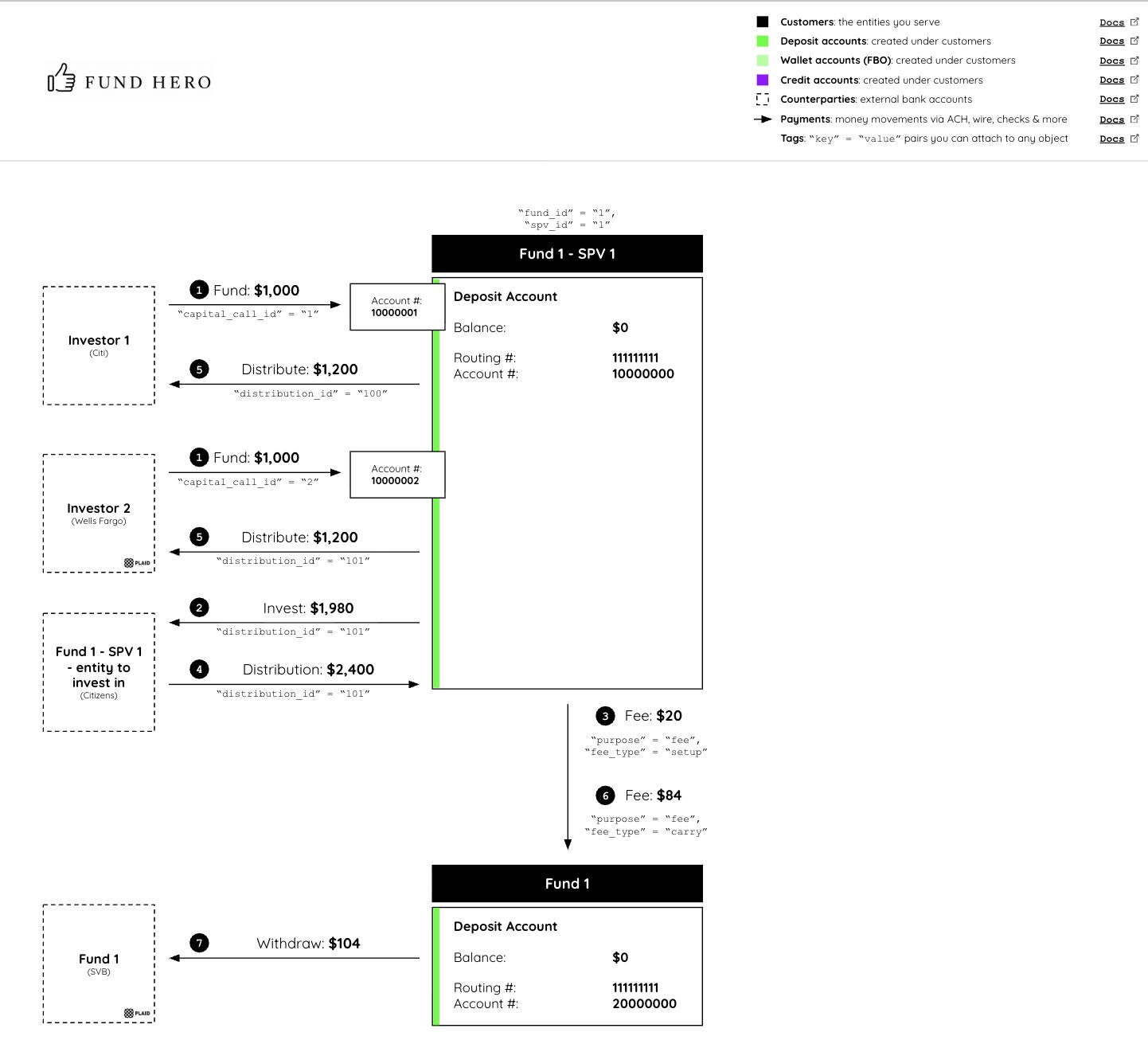
What infrastructure does a fund management platform need before money can move?
When a fund signs up for Fund Hero, the platform opens an account for the fund (bottom green box).
When that fund wants to invest in something, the platform opens a single account for the SPV associated with the investment (top green box).
Adding tags like fund_id: 1 to funds can make it easier for Fund Hero to program & operate the money movement that comes next.
How does the investment phase work?
Investors are invited to send money and complete their investment. They are instructed to log into their bank account, and initiate the money movement. See (1). Fund Hero can use a virtual account number per investor (small white boxes), to simplify matching every incoming investment with the right investor.
Fund Hero sends all the money that was received from investors to the destination. For example, a startup in the case of VC investment. Or a building in the case of real estate investment. See (2).
Fund Hero can help the fund to charge fees for the setup phase. See (3).
Adding tags like capital_call_id: 1 to money movement can make it easier for Fund Hero to program & operate money movement with correctness guarantees.
If the fund requires investors to invest gradually over time (what’s known as “capital calls”), what we described simply repeats over time.
How does the distribution phase work?
The fun part! Fund Hero helps the fund receive money from the investment target, for example when a startup exits. See (4).
Investors receive their share of the distribution. See (5).
Fund Hero can help the fund to charge fees for any profit. See (6). Funds can simply choose if / when they want to withdraw funds from the platform.
Adding tags like distribution_id: 1 to money movement can make it easier for Fund Hero to program & operate money movement with correctness guarantees.
If the fund distributes gradually over time (common in real estate, for example), what we described simply repeats over time.
Advanced features for fund platforms building at scale
Some flows that we didn’t describe in the diagram, to keep it simple, but have encountered in advanced fund use cases:
1. Choosing deposit accounts or wallet accounts (FBO)
For the green boxes, Fund Hero can choose between deposit accounts or wallet accounts (FBO). AngelList chooses wallet accounts, for example. I described the difference between deposit accounts and wallet accounts (FBO) in this post.
2. Pulling from external investor accounts
A MUCH stronger user experience would be to automatically complete funding for investors, by originating an ACH debit. See (1). It requires taking meaningful risk, so most platforms don’t do it, or do it only for a small trusted set of investors
3. Giving individual investors their own accounts
Some platforms, like AngelList, choose to keep funds “on the platform”. They offer individual investors their own balances, and distribute into these balances. They do it because it allows them to save on money movement, earn interest (or offer interest), and create a better investor experience. Investors can simply choose if / when they want to withdraw funds from the platform.
4. Charging fees
Just like the funds they serve, Fund Hero can choose to charge fees itself.
Itai Damti is the co-founder and CEO of Unit, the financial infrastructure that powers accounts, money movement, cards, and capital for software companies. The fund management architecture described above reflects patterns Unit has helped build across the platforms it supports.
This content is for educational and informational purposes only. It does not constitute legal, financial, investment, or compliance advice. The flows, account structures, and patterns described are illustrative examples and may not reflect the specific requirements of any regulated program. Platform builders should consult qualified legal and compliance counsel before implementing any financial product.


