Why agents need financial infrastructure


If an agent improves your accounts payable process but can't initiate an authorized payment workflow, it hasn't finished the job. It’s done everything in software: extracted the invoice, matched it to the purchase order, routed it for approval, confirmed the terms, and then it stopped.
Many products now have the intelligence to guide financial decisions; the next step is giving them a secure, authorized, and controlled way to act on those decisions.
The last step: trust and financial execution
Turning financial intelligence into action requires two things: trust and execution.
Trust comes from context. The companies best positioned to build these workflows already understand their customers’ financial lives, including invoices, spending, balances, cash flow, and payment obligations. They have both the customer relationship and the data needed to make informed decisions.
Execution turns those decisions into completed work. An agent may know that a payment should be sent or funds should be moved, but acting on that insight requires bank relationships, payment rails, compliance, ledgering, and controls. Without those capabilities, the agent can only recommend the next step. The customer still has to leave the product, open another tool, or hand the workflow off to a separate vendor.
This agent-to-customer handoff breaks the agentic experience. To keep the workflow moving, financial execution needs to be built in. The agent should be able to call an API within authorized permissions and configured controls, receive a result, and continue to the next step in the workflow.
Teams building closed-loop financial workflows
Cleo has built a scaled AI financial assistant - it publicly describes Autopilot as a step toward autonomous money management. Cleo has over 1M paying subscribers and $400 million in ARR. For most of its history, the product was a financial coach: it analyzed spending, remembered goals, and told users what to do. When the team built Autopilot, Cleo was able to help carry decisions through to execution under user-authorized rules and permissions.
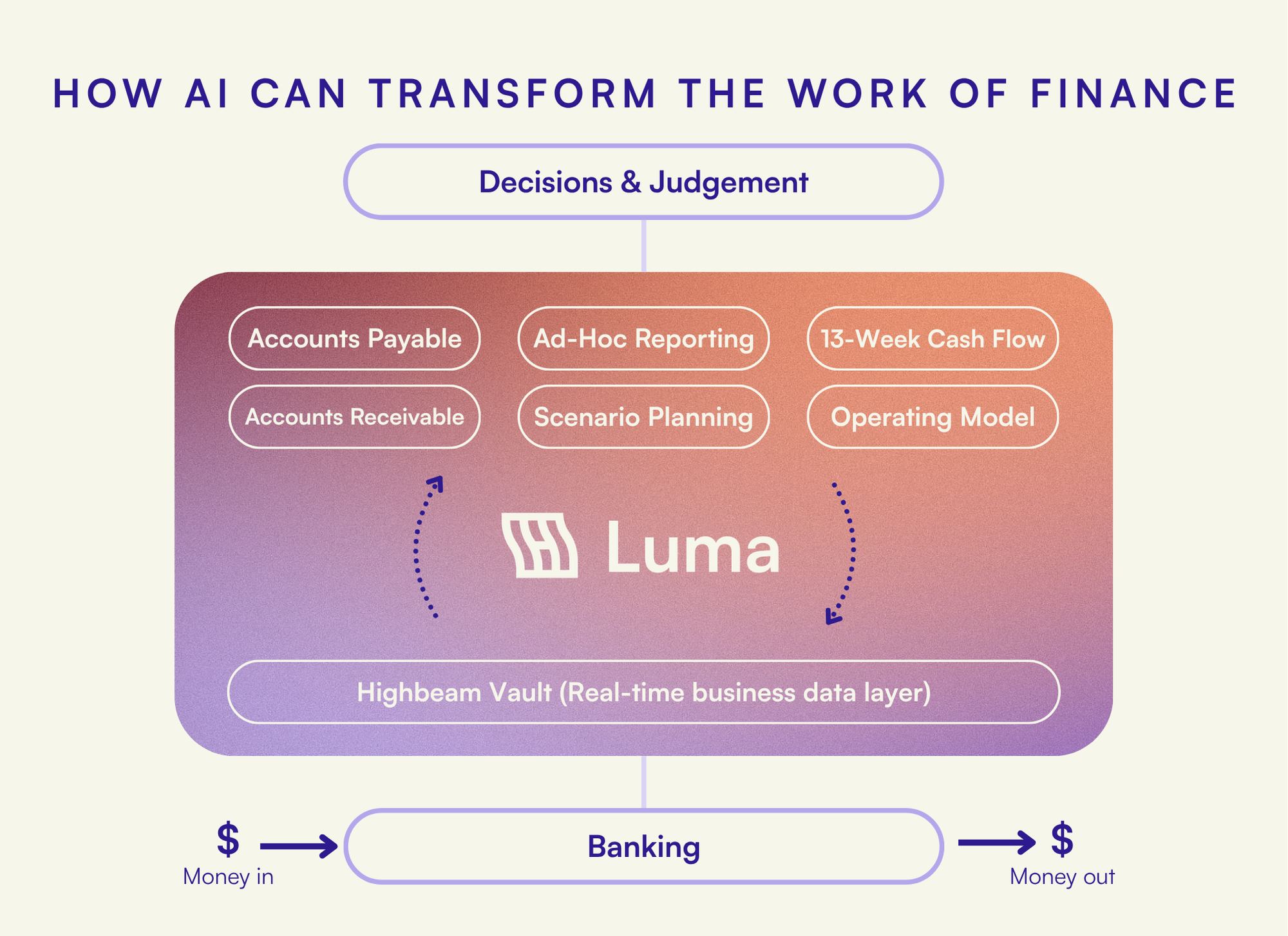
Highbeam applies the same concept to direct-to-consumer brands. Its agentic product, Luma, combines a real-time view of cash, forecasting, bill pay, and treasury. Based on rules set by the operator, Luma can help manage movement across operating accounts, savings products, and financing tools, subject to the operator’s rules and the applicable account, payment, and financing structures. The workflow moves from analysis to action while staying inside the product.
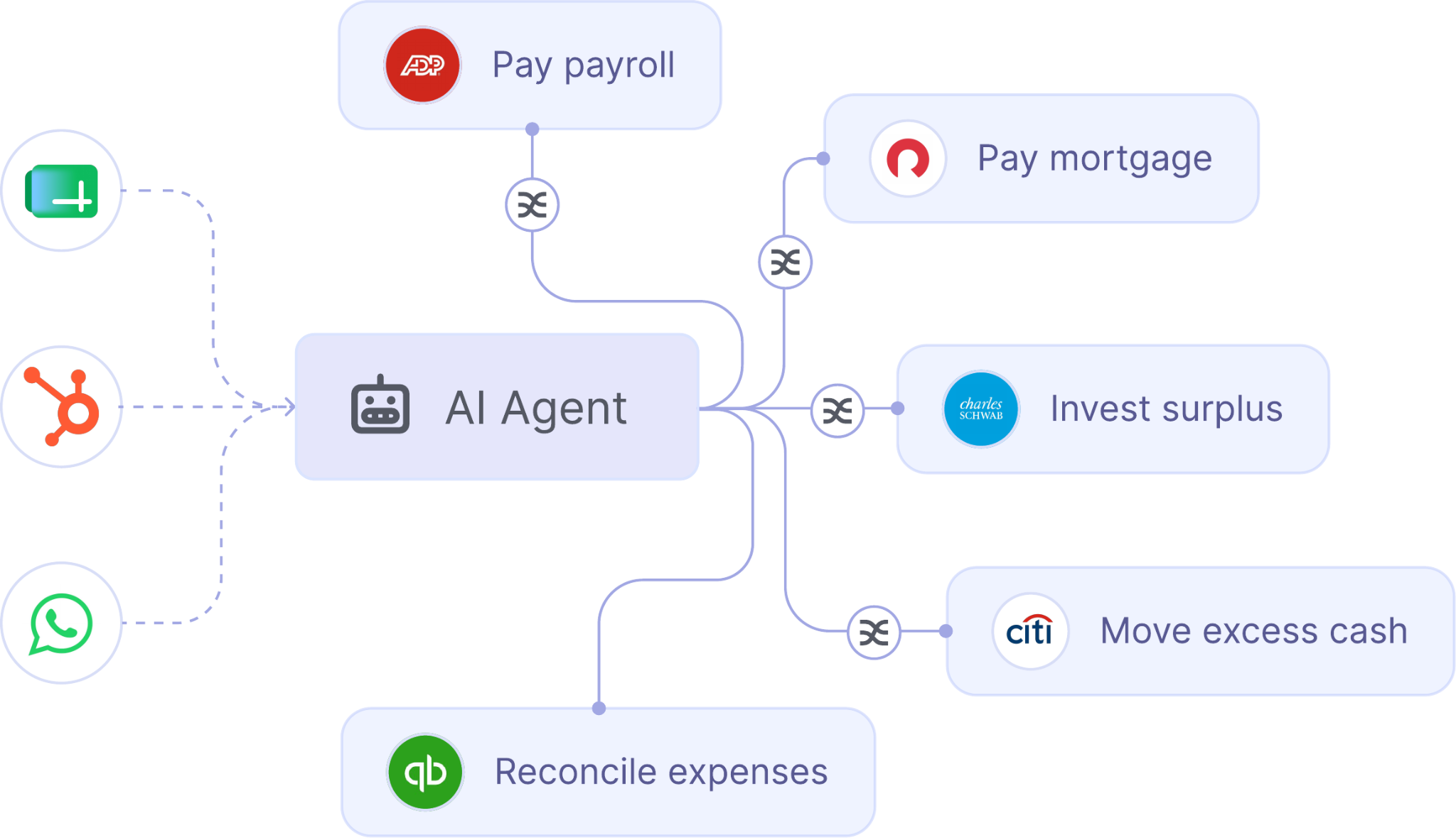
Sequence takes the same approach in a different direction. The product is a financial router that lets AI agents initiate rule-based financial workflows for consumers and small business owners. The builder defines how money should move between accounts, pods, and goals; the agent initiates the applicable workflow within the rules and permissions the builder defines.
All three teams developed financial intelligence, built trust across the customer base, and then connected the product to financial execution with Unit’s infrastructure. Each product became more valuable when it went beyond recommending the next step to supporting the authorized execution layer needed to complete the workflow.
Why the infrastructure underneath the agent matters
Not all financial infrastructure is designed for programmable execution. Unit connects directly to FedACH, Fedwire, card networks, and check infrastructure, with no intermediary introducing latency or additional failure points.
The ledger is native to Unit’s platform, with real-time account activation and reconciliation workflows. Because supported rails and account primitives run on the same system of record, agentic products can move across workflows without stitching together vendors or reconciling separate systems. They can confirm payment status through the API using network-level identifiers and settlement-related status and timing data, while webhooks surface returns or failures in real time.
The control layer matters too: it defines when agents should be allowed to act, which actions require human approval, what limits apply, and how each action is recorded. Builders can define those rules for agent behavior within available platform controls, program terms, and applicable limits, while audit logs in the Unit dashboard help teams trace the activity that occurred. This traceability is critical: product, operations, compliance, and support teams need to understand what action was taken, when it happened, which object changed, and what state the payment is in. Agentic financial execution must be observable, reviewable, and operationally manageable.
A single platform providing comprehensive account primitives and rails makes these workflows easier to operate reliably at scale. Unit processes over $100 billion in annualized transaction volume and handles more than 15 million API calls per day.
If you're building this now
For builders actively integrating financial execution into an agent: the quickstart covers the core objects in one hands-on sandbox flow. The ACH, wire, and check payment docs provide full request/response examples for each rail.
For product and engineering leaders evaluating whether to build: the Cleo and Highbeam examples illustrate how financial intelligence can connect to authorized financial workflows at scale. To talk through how execution would fit your specific architecture, talk to our team.
Unit is a financial technology company and is not a bank. Banking products and services are provided by Unit’s partner bank(s), Members FDIC.
Financial products, payment capabilities, card programs, capital products, and automated or agent-enabled workflows are subject to applicable terms, eligibility, approvals, customer authorization, transaction limits, risk reviews, partner bank requirements, provider requirements, and program configuration. Unit provides technology infrastructure and platform services, and in certain implementation models, program management services, to support financial products and payment workflows. Unit does not provide FDIC insurance, hold customer deposits, or lend directly.
Customer examples are provided for illustrative purposes only. Product capabilities, supported workflows, timing, implementation models, results, approval, control transaction volume, customer adoption, responsibilities, and operational outcomes vary by program, customer, product design, partner bank, provider, and applicable requirements. References to agent-enabled or automated workflows do not mean that payments occur without customer authorization, applicable controls, or required reviews.
Frequently asked questions
Why can't an AI agent move money without financial infrastructure?
Moving money typically requires regulated financial products, payment rails, financial institutions, and compliance and risk controls. Depending on the product and flow, that may include a bank partner, payment network, licensed provider, KYC/KYB, sanctions screening, transaction monitoring, fraud controls, user authorization, and transaction limits. An agent's decision doesn't satisfy those requirements on its own.
Financial infrastructure is what closes the gap. It can connect the agent to payment rails and account workflows, enforces the bank's and the company's rules before a payment is processed, and screens each action against regulatory requirements. It also produces an auditable record of who initiated or approved an action, what changed, when and why it occurred.
So the agent may supply or initiate the intent. The infrastructure controls, authorizations, and applicable financial institution relationships are what make that intent capable of becoming an authorized payment or account workflow.
What payment rails does Unit expose through its API?
Unit’s API supports multiple payment and financial products, including direct access to ACH and same-day ACH, domestic and international wires, RTP, card issuance and processing, and checks.
How does an agent handle failed or returned payments?
Unit webhooks can surface relevant payment state changes, including settlement confirmations, returns, and failures, so an agent-enabled product subscribed to those events can respond to events rather than polling for status. What makes autonomous handling actually work is what's in the payload: Unit returns the raw network data behind each event, not just a generic "failed" flag. For ACH, that means the actual return reason code, so an agent can branch its own behavior: retry on an R01 (insufficient funds), suppress and flag on an R02 (account closed) or R03 (no account found), and route edge cases to a human. For wires, IMAD/OMAD trace identifiers and real settlement dates let the agent confirm delivery and reconcile against the ledger without a human opening a bank portal. The generic status tells an agent that something happened; the raw code and trace tell it what to do next.
How do you keep an AI agent from moving money it shouldn’t?
Pricing, fees, interest, and limits can be enforced by Unit’s enforcement engine at the platform layer, applied automatically from the terms and limits assigned to each customer. An agent can request a payment, but it can't underprice it, skip a fee, or push it past the account's limits, because those controls are enforced independently at the platform layer, regardless of how the agent is programmed. Each request is evaluated against the applicable limits and rules before it reaches the rail; anything outside them is blocked and recorded for review. Builders can also set which actions an agent may initiate on its own versus which route to a human first. The result: the agent operates inside a boundary it can't talk its way out of.
Has agent-initiated money movement been proven at scale?
Yes. Cleo publicly stated that Cleo's Autopilot moves money on behalf of over 1 million paying subscribers. Highbeam publicly described Luma as built from experience with over $15 billion in transactions across 500-plus direct-to-consumer brands. Both companies use Unit to power the underlying money movement.