

How interest rates affect companies that store, move, and lend Money


The Federal Reserve increased the interest rate by 0.25% this week, to 3.75% - 4.00%. This impacts every company building in financial services.
Who wins and loses?
🟢 Companies that STORE money WIN, because they can advertise or make up to 0.25% more, while money is stored at the bank.
🟢 Companies that MOVE money WIN, because they make up to 0.25% more, while money is temporarily stored at the bank before or after it moves.
🔴 Companies that LEND money LOSE, because their cost of capital goes up 0.25%.
How does the math work for the winners?
STORE + MOVE money
- When choosing a bank, companies negotiate a rate with the bank.
- Every dollar stored or temporarily stored is eligible for interest at the end of the month.
- These companies apply formulas that give some of the money to end-customers, and the rest to themselves.
- The companies might want to pay different users differently. For example, 3% to a “gold user” and 1% to the rest. In public advertising, they might say "up to 3%".
Who runs the formulas for every account?
Ideally, NOT YOU.
Interest calculations are incredibly complex and heavily regulated. They are based on accruals over nightly balances, they should be reconciled, and they must be calculated as advertised. I have once seen a case of stochastic (non-deterministic) rounding that attracted regulatory attention during an exam, because it led to a $0.07 difference on $700m+ in deposits (!).
Three modes that companies use for interest
At Unit we've seen 3 modes that companies use for interest, and we made them available at an account level:
- SINGLE RATE
- TIERS + MULTIPLE RATES
- TIERS + SINGLE RATE
The diagram shows how the mode might apply to one account. Remember that different accounts might be subject to different modes, and their own rates under the mode. It gets complex.
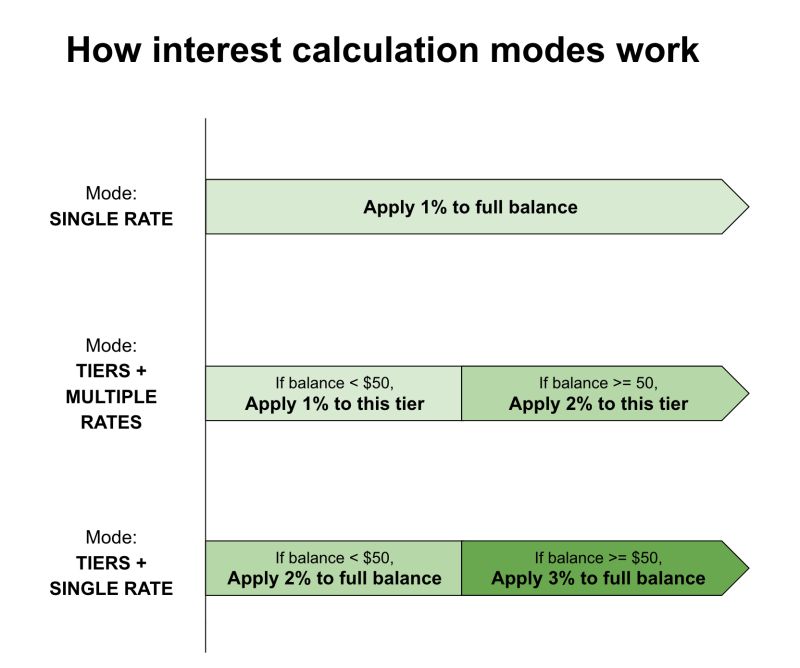
Let’s explain how it works with an example:
- A company called CommerceHero serves e-commerce businesses, and wants to offer them balances and cards.
- It negotiates with its bank the rate of Fed midpoint (3.875%) minus 20%. That’s 3.1%.
- During the month, all balances in all accounts accrue interest DAILY. But it’s a “silent accrual” and nothing is paid yet.
- The accrual happens according to the mode, and the rate CommerceHero decided to offer each user.
- At the end of the month, all accounts are credited with the interest. They simply have an interest payment in their account.
- In this moment, CommerceHero also gets credited a large sum, for the difference between the rate it negotiated (3.1%) and what users got paid. It could even be a $1m drop!
Want to dive deeper? Read more on interest here.


