

Real-Time Accounting Built on Financial Infrastructure
Software companies using Unit can offer up-to-date accounting that reflects cash activity instantly, without manual reconciliation or delayed data.


Software companies building on Unit can now power real-time accounting for their end customers.
We are excited to announce our partnership with Layer, which brings real-time accounting and bookkeeping capabilities directly on top of Unit’s financial infrastructure.
With this integration, platforms using Unit can stream transaction data directly into Layer, creating a seamless connection between money movement and accounting that gives SMBs an up-to-date view of their financials, without manual work or 12–24 hour data delays.
Why It Matters
At Unit, our vision is to help our partners build a single money hub where businesses can store, move, spend, and understand their money in one place. Real-time accounting is a critical part of that experience.
Embedded finance is most powerful when it becomes the system of record for a business’s money. Account and transaction data are the ground truth of revenue, spend, and cash flow, but too often, that data is siloed or delayed before it reaches accounting systems.
Traditional bank connectors introduce latency, reconciliation overhead, and gaps in financial reporting, with delays of 12–24 hours or more. That lag limits how useful financial insights can be for SMBs making daily decisions.
By integrating Unit directly with Layer, platforms can offer accounting that updates in real-time as transactions occur. Financial reports reflect actual cash activity the moment money moves, enabling faster decisions, better forecasting, and greater confidence in the numbers.
How It Works
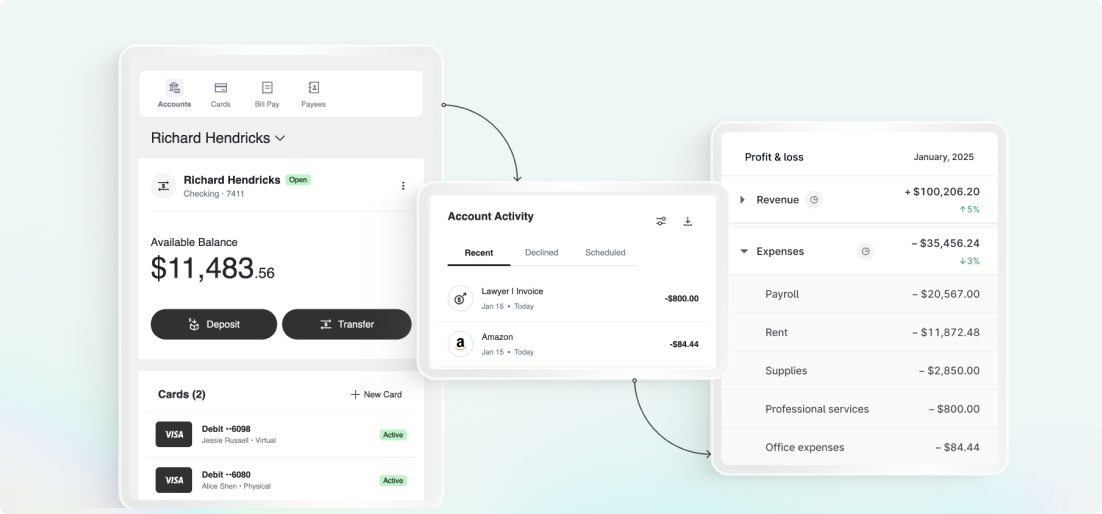
Our new integration automatically syncs all Unit-powered financial activity directly into Layer.
Account and transaction data flow directly from Unit into Layer’s accounting engine, where they are categorized and reflected in core financial statements such as profit and loss and balance sheets in real time. Because the data comes straight from the source of funds, financials stay accurate without manual reconciliation or delayed imports.
For software platforms, this means less operational complexity and a tighter, more reliable financial stack. For SMBs, it means accounting that finally keeps up with how their money actually moves.
* Unit and Layer are software infrastructure providers and do not provide accounting, tax, or financial advisory services.


